

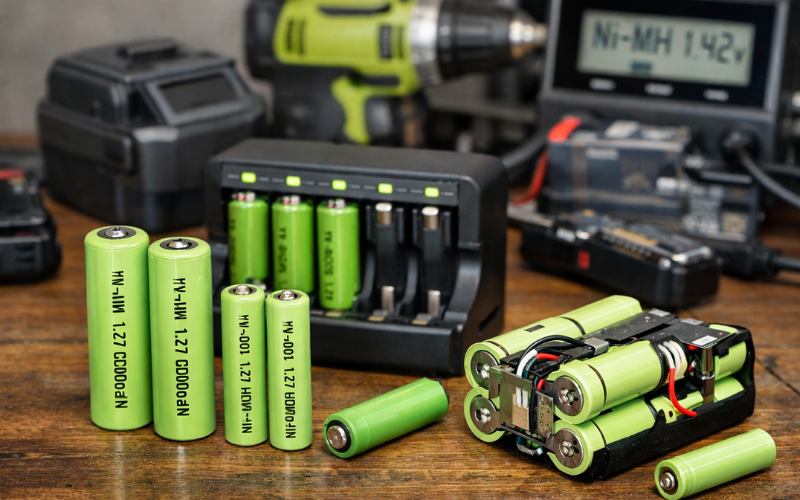
Introduction
A NiMH battery, short for Nickel-Metal Hydride battery, is a type of rechargeable power source that has remained relevant for decades despite rapid advances in battery technology. People still search for NiMH batteries today because they offer a practical balance of safety, performance, cost, and environmental responsibility. From household electronics to professional equipment, the NiMH battery continues to fill an important role in modern rechargeable power systems where reliability and ease of use matter more than cutting-edge chemistry.
What a NiMH Battery Is and How It Works
A NiMH battery stores electrical energy using a chemical reaction between nickel oxide hydroxide and a hydrogen-absorbing metal alloy. When the battery is charged, energy is stored in this chemical form. When it is used, the chemical reaction reverses and releases electricity to power a device.
Each NiMH battery cell produces a nominal voltage of about 1.2 volts. While this is slightly lower than the 1.5 volts provided by disposable alkaline batteries, most electronic devices are designed to operate within a voltage range and continue working normally as voltage drops. This makes a NiMH battery a direct and reliable replacement for common single-use batteries in everyday devices.
What makes the NiMH battery especially practical is its rechargeable nature. Instead of being discarded after use, it can be recharged hundreds or even thousands of times, reducing waste and long-term costs.
Key Characteristics That Define a NiMH Battery
Rechargeability, voltage behavior, and energy storage explained simply
One of the defining features of a NiMH battery is its ability to be recharged repeatedly without major performance loss when used correctly. A quality NiMH battery can handle hundreds to over a thousand charge cycles, depending on its design and how it is used.
The voltage behavior of a NiMH battery is stable during use. Unlike alkaline batteries, which steadily lose voltage as they discharge, a NiMH battery delivers a more consistent voltage for most of its charge. This consistency is helpful for devices that require steady power, such as cameras, wireless controllers, and medical tools.
In terms of energy storage, a NiMH battery offers higher energy density than older nickel-cadmium batteries. This means it can store more energy in the same physical size, allowing longer usage times between charges. While it does not match the energy density of modern lithium-ion batteries, the NiMH battery remains competitive for standard consumer battery sizes like AA and AAA.
Another important characteristic is environmental safety. NiMH batteries do not contain cadmium or lead, making them safer to manufacture, recycle, and dispose of compared to older battery types.
NiMH Battery Performance Compared to Other Battery Types
When comparing a NiMH battery to disposable alkaline batteries, the main difference lies in rechargeability and performance under load. Alkaline batteries are inexpensive upfront but must be replaced frequently. A NiMH battery, although more expensive initially, becomes more cost-effective over time due to repeated use.
Compared to lithium-ion batteries, a NiMH battery is heavier and stores less energy for its size. However, it offers advantages in safety and simplicity. NiMH batteries are less sensitive to overcharging, physical damage, and extreme temperatures, making them suitable for devices that require durability rather than maximum energy density.
When compared to older nickel-cadmium batteries, the NiMH battery clearly improves on energy storage and environmental impact. It also reduces concerns related to the strong memory effect that plagued NiCd technology.
Self-Discharge and the Rise of Low-Self-Discharge NiMH Batteries
How modern NiMH batteries hold charge longer than older versions
Traditional NiMH batteries were known for relatively high self-discharge rates. This meant that even when not in use, the battery would slowly lose its stored charge over time. For users, this could be frustrating, especially when picking up a device that had been stored for weeks or months.
Modern low-self-discharge NiMH batteries have significantly improved this issue. Advances in materials and manufacturing have reduced internal energy loss, allowing these batteries to retain a large portion of their charge during storage. Many modern NiMH batteries can keep most of their charge for several years when stored properly.
This improvement has changed how people view NiMH batteries. They are no longer just an option for frequent charging cycles but also a reliable choice for devices that are used occasionally, such as emergency lights, backup controllers, and household electronics.
Where NiMH Batteries Are Commonly Used Today
Today, the NiMH battery is widely used in consumer electronics that demand consistent power. Devices such as digital cameras, wireless keyboards and mice, game controllers, toys, flashlights, and personal care products benefit from the steady voltage and high current delivery of NiMH batteries.
In professional and industrial settings, NiMH batteries are used in medical equipment, emergency lighting systems, alarms, and portable tools. Their reliability and safety profile make them suitable for environments where battery failure is not acceptable.
Although many modern hybrid vehicles have transitioned to lithium-ion technology, NiMH batteries are still found in older hybrid systems and continue to be valued for their durability and long service life in automotive applications.
Advantages and Limitations of Using a NiMH Battery
A major advantage of using a NiMH battery is its long-term value. Recharging a single battery hundreds of times reduces waste and lowers overall cost. The environmental benefit of reduced battery disposal is another important factor for both consumers and organizations.
NiMH batteries also perform well in high-drain devices. They can deliver strong current without sudden voltage drops, which helps devices operate smoothly and efficiently.
However, there are limitations to consider. NiMH batteries are heavier than lithium-based alternatives and have lower energy density. This means they are not ideal for compact devices where weight and size are critical. Charging speed is also slower compared to some modern battery technologies, and improper charging can reduce lifespan.
How to Choose the Right NiMH Battery for Your Device
Capacity, cycle life, and usage patterns that matter
Choosing the right NiMH battery depends on how the device is used. Capacity, measured in milliamp-hours, indicates how long the battery can power a device before needing a recharge. Higher capacity generally means longer runtime, but it can also come with a shorter overall cycle life.
Cycle life refers to how many times a battery can be charged and discharged before its performance noticeably declines. Devices used daily may benefit from batteries designed for long cycle life, while high-drain devices may require higher capacity even if the cycle count is lower.
Usage patterns also matter. For devices that sit unused for long periods, low-self-discharge NiMH batteries are a better choice. For devices that are recharged frequently, standard NiMH batteries may be sufficient.
Conclusion
The NiMH battery remains an important part of modern rechargeable power solutions. Its balance of reliability, environmental safety, steady performance, and long-term value keeps it relevant even as new battery technologies emerge. For everyday electronics, professional equipment, and applications where durability matters, the NiMH battery continues to be a practical and trusted choice. By understanding how it works, where it performs best, and how to choose the right option, users can make informed decisions that benefit both their devices and the environment.
FAQs
1. What is the lifespan of a NiMH battery?
A NiMH battery can last several years and handle hundreds to over a thousand charge cycles, depending on usage, charging habits, and battery quality.
2. Are NiMH batteries better than alkaline batteries?
For devices used regularly, NiMH batteries are usually better because they can be recharged many times and provide steady power. Alkaline batteries may be more convenient for occasional use but are less cost-effective over time.
3. Do NiMH batteries suffer from memory effect?
NiMH batteries are much less affected by memory effect than older nickel-cadmium batteries. Occasional full discharge can help maintain performance, but it is not strictly required.
4. Can a NiMH battery be used in devices designed for 1.5V cells?
Yes, most devices designed for 1.5V alkaline batteries work well with 1.2V NiMH batteries because they are designed to operate across a voltage range.