

Introduction
Outdoor broadcasting is the process of producing live television or radio content from locations outside a fixed studio. It allows broadcasters to bring real events directly to viewers as they happen, whether those events take place in a stadium, on a city street, or at a cultural gathering. Even with the rise of digital media and remote tools, people continue to search for outdoor broadcasting because it remains essential for real-time coverage, authenticity, and audience trust in modern media production.
Understanding the Meaning of Outdoor Broadcasting in Modern Media
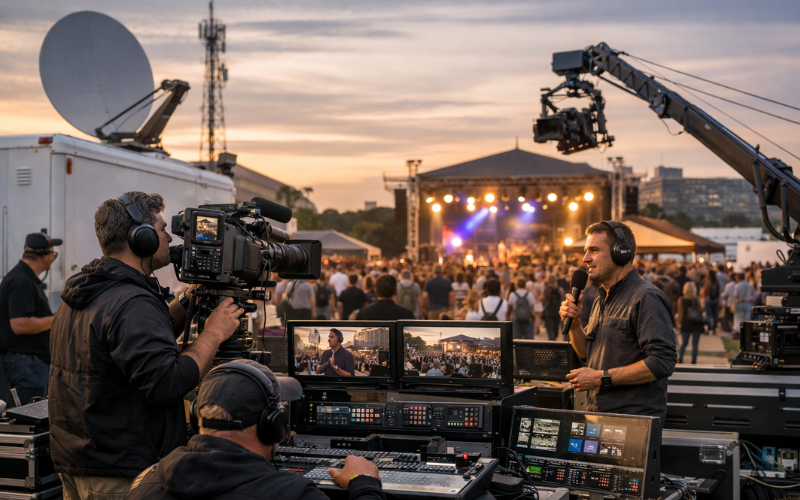
Outdoor broadcasting, often called outside broadcasting or OB, refers to taking the full capability of a broadcast studio into the field. Instead of working within a controlled indoor environment, production teams operate directly at the event location. This approach allows audiences to experience events as they unfold in real time, with natural sound, live visuals, and immediate reporting. In modern media, outdoor broadcasting is valued because it connects viewers more closely to reality. It reduces the distance between the event and the audience, making coverage feel more direct, timely, and credible.
How Outdoor Broadcasting Differs from Studio-Based Production
Studio-based production happens in a fixed, controlled space where lighting, sound, and timing are carefully managed. Outdoor broadcasting, on the other hand, takes place in unpredictable environments. Weather conditions, crowd movement, and technical limitations all play a role. Unlike studios, outdoor setups must be flexible and mobile. Crews need to adapt quickly, manage multiple variables, and still deliver high-quality live content. This difference is why outdoor broadcasting requires specialized planning, equipment, and experience compared to traditional studio work.
Core Elements That Make Outdoor Broadcasting Possible
Outdoor broadcasting relies on several key components working together smoothly. One of the most important elements is the OB van or mobile production unit. These vehicles act as moving control rooms, housing equipment that manages video switching, sound mixing, and live coordination. Alongside the van, cameras and microphones are placed around the event location to capture different angles and audio sources. Crew members communicate constantly to ensure smooth coverage. Another critical element is signal transmission. Live footage must be sent back to a broadcast center or directly to viewers using satellite links, fiber connections, or modern cellular networks. Without reliable transmission, outdoor broadcasting would not be possible.
Where Outdoor Broadcasting Is Commonly Used Today
Outdoor broadcasting is widely used across many areas of media. Sports coverage is one of the most visible examples, where live matches, races, and tournaments depend on on-location production to capture fast-moving action. News organizations rely on outdoor broadcasting for breaking news, allowing reporters to share updates directly from the scene. Entertainment events such as concerts, festivals, and award ceremonies also use outdoor broadcasting to bring large-scale experiences to remote audiences. Public events, cultural celebrations, and national ceremonies further show how outdoor broadcasting remains central to shared viewing experiences.
How Technology Is Changing Outdoor Broadcasting
Technology has reshaped outdoor broadcasting in recent years, making it more efficient and adaptable. Remote production models now allow some crew members to work from central locations while only essential equipment and staff are sent to the event. This reduces travel costs and speeds up setup times. Internet-based systems have replaced many traditional cables, allowing video and audio signals to move through flexible digital networks. Artificial intelligence is also playing a growing role by assisting with live captions, automated highlights, and faster content processing after events. These changes show how outdoor broadcasting continues to evolve while keeping its core purpose intact.
Real-World Challenges Faced in Outdoor Broadcasting
Despite advancements, outdoor broadcasting still faces real-world challenges. Logistics can be complex, especially when covering events in remote or crowded locations. Equipment must be transported, powered, and protected from weather conditions. Costs remain high due to staffing, travel, and technical requirements. Connectivity issues can affect signal quality, particularly in areas with limited network access. Environmental concerns are also becoming more important, pushing broadcasters to find cleaner power solutions and reduce their carbon footprint. Managing these challenges requires careful planning and experienced teams.
The Future Direction of Outdoor Broadcasting
The future of outdoor broadcasting focuses on efficiency, sustainability, and flexibility. Broadcasters are exploring cleaner energy sources for mobile units and reducing the physical footprint of on-site operations. Hybrid models that combine on-location capture with remote control rooms are becoming more common. As audiences continue to value live, real-world coverage, outdoor broadcasting is expected to remain relevant. Its ability to adapt to new technologies while preserving trust and immediacy keeps it central to modern media.
Conclusion
Outdoor broadcasting continues to play a vital role in media by bringing real events directly to audiences. While technology has changed how it operates, the need for live, on-location coverage remains strong. By combining mobility, innovation, and adaptability, outdoor broadcasting still matters today and will continue to shape how people experience live media in the years ahead.
FAQs
1. What is outdoor broadcasting used for today?
Outdoor broadcasting is used for live sports, breaking news, concerts, public events, and any situation where real-time coverage from the event location is important.
2. How does an OB van function during live events?
An OB van acts as a mobile control room. It manages camera feeds, sound, and live switching to ensure the broadcast runs smoothly.
3. Is outdoor broadcasting still relevant with remote production?
Yes, outdoor broadcasting remains relevant because on-location capture provides realism and immediacy that remote-only setups cannot fully replace.
4. What technologies are replacing traditional OB setups?
Internet-based networks, cloud systems, and remote production tools are reducing reliance on older cable-based setups while keeping the core concept of outdoor broadcasting alive.