

Introduction
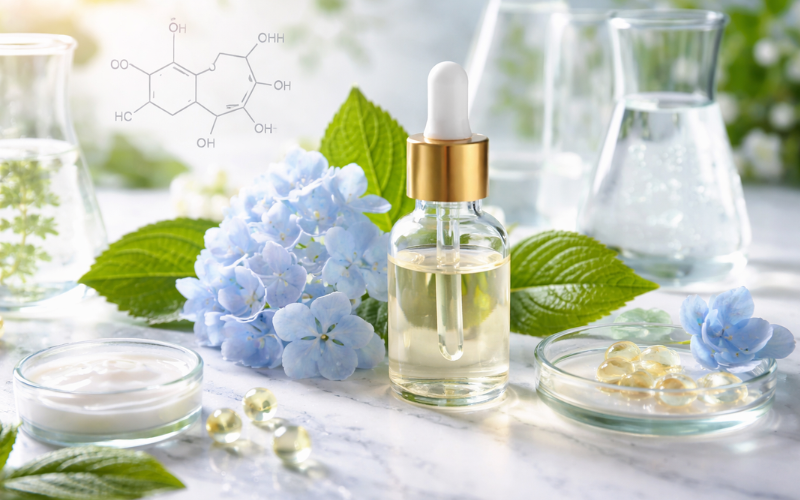
Hydrangenol is a natural plant compound that has been gaining attention in recent years, especially in the world of skincare and health research. While it may not yet be a household name, scientists and dermatology experts are increasingly studying hydrangenol for its potential anti-aging, anti-inflammatory, and skin-protective properties.
This compound is mainly found in certain Hydrangea species, plants that have been used in traditional herbal practices for centuries. Today, modern research is taking a closer look at hydrangenol to understand how it may help protect the skin from damage, support collagen, and improve overall skin health.
What Is Hydrangenol?
Hydrangenol is a natural compound classified as a dihydroisocoumarin. This means it belongs to a group of plant-based molecules known for their biological activity. Scientists have isolated hydrangenol mainly from the leaves of Hydrangea serrata and Hydrangea macrophylla, though it has also been found in some related plants.
Researchers are interested in hydrangenol because it appears to influence several biological pathways related to skin aging, inflammation, and oxidative stress. In simple terms, it may help the skin defend itself against environmental damage while supporting repair processes.
Although hydrangenol has roots in traditional plant use, most of the excitement today comes from laboratory studies that show promising effects on skin cells and inflammatory markers.
The Chemistry Behind Hydrangenol
From a chemical standpoint, hydrangenol has the molecular formula C₁₅H₁₂O₄. Its structure allows it to interact with certain proteins and enzymes inside cells. This interaction is what gives hydrangenol its biological activity.
The shape and arrangement of atoms in hydrangenol help it act as an antioxidant. Antioxidants are substances that reduce damage caused by free radicals, which are unstable molecules formed by UV radiation, pollution, and normal metabolism.
When formulators consider hydrangenol for skincare or supplements, they must also think about stability. Plant-derived compounds can break down under heat, light, or air exposure. For this reason, proper extraction, storage, and formulation are important to maintain its activity.
Hydrangenol and Skin Health
Hydrangenol is most widely studied for its potential benefits to skin health. Dermatology research focuses on how the compound affects aging-related processes and inflammation in skin cells.
One key reason hydrangenol attracts attention is its possible ability to reduce oxidative stress. Environmental factors like sunlight and pollution create stress inside the skin. Over time, this stress can lead to wrinkles, uneven texture, and loss of firmness. Laboratory studies suggest that hydrangenol may help protect skin cells from this type of damage.
In modern skincare science, ingredients that support both protection and repair are highly valued. Hydrangenol appears to fit into this category, as it may support the skin’s natural defense systems while also influencing collagen production.
Anti-Photoaging Effects and UV Protection
Photoaging refers to premature skin aging caused by repeated exposure to ultraviolet (UV) rays. UVB radiation, in particular, can trigger inflammation, increase enzyme activity that breaks down collagen, and generate free radicals.
Studies suggest that hydrangenol may help reduce UV-induced damage. One proposed mechanism involves activation of the Nrf2 pathway. Nrf2 is a protective system inside the body that controls the production of antioxidant enzymes. When activated, it helps neutralize harmful molecules and reduce cellular stress.
By supporting this pathway, hydrangenol may lower the level of damage caused by UV exposure. Some research also shows that it can reduce the expression of certain inflammatory molecules triggered by UV radiation. These combined effects are why hydrangenol is being explored as a potential anti-photoaging ingredient.
Collagen Support and Wrinkle Reduction Mechanisms
Collagen is the protein responsible for skin strength and firmness. As we age, collagen production slows down, and enzymes that break down collagen become more active. This leads to wrinkles and sagging.
Hydrangenol has been studied for its effect on Pro-COL1A1, a marker linked to collagen production. Some findings suggest that it may increase this marker, which could support collagen synthesis. At the same time, hydrangenol appears to reduce the activity of enzymes such as MMP-1 and MMP-3. These enzymes are known to degrade collagen in aging or sun-exposed skin.
When collagen breakdown slows and new collagen production is supported, the skin may maintain better elasticity and structure. While more human research is needed, these mechanisms explain why hydrangenol is being discussed in anti-aging research.
Skin Barrier Support and Moisturization Benefits
Healthy skin depends on a strong barrier. This barrier prevents moisture loss and protects against irritants and allergens. Certain proteins, including filaggrin and involucrin, play an important role in maintaining this barrier.
Research indicates that hydrangenol may increase the expression of these proteins. It has also been linked to aquaporin-3, a molecule involved in water transport within the skin. By supporting these factors, hydrangenol may help improve hydration and strengthen the skin’s outer layer.
For people with dry or sensitive skin, ingredients that reinforce the barrier can be especially helpful. While hydrangenol is still under study, its potential role in barrier support adds to its appeal in skincare science.
Anti-Inflammatory and Anti-Allergic Properties
Inflammation is a common factor in many skin concerns, including redness, irritation, and certain chronic conditions. Laboratory studies show that hydrangenol can reduce the production of inflammatory mediators such as iNOS, COX-2, and TNF-α in various models.
This suggests that hydrangenol may help calm inflammatory responses in the skin. In addition, some research indicates possible anti-allergic activity. These effects may be linked to how hydrangenol interacts with immune-related pathways.
It is important to note that most of these findings come from cell and animal studies. Human trials are limited, so conclusions should be made carefully. However, the early evidence supports continued research into hydrangenol’s anti-inflammatory potential.
Emerging Research: Hair Growth and Metabolic Health
Beyond skincare, hydrangenol is being studied for other possible health benefits. One area of interest is hair growth. Some studies suggest that hydrangenol and extracts from Hydrangea serrata may inhibit 5α-reductase, an enzyme linked to hair thinning. It may also support the growth of dermal papilla cells, which are important for hair development.
Researchers are also exploring its potential role in metabolic health. Early studies suggest possible antidiabetic effects, though these findings are still preliminary.
In Japan, processed hydrangea leaves are used to make a sweet herbal tea known as “amacha.” While this traditional use does not focus specifically on hydrangenol alone, it highlights the plant’s long history of human use.
Safety, Sensitivity, and Usage Considerations
Although hydrangenol shows promising benefits, safety is an important consideration. The raw plant material from Hydrangea species can act as a contact sensitizer, meaning it may cause skin irritation or allergic reactions in some people.
It is important to distinguish between raw plant exposure and carefully formulated extracts. Controlled formulations are designed to reduce unwanted reactions, but individual sensitivity can still vary.
Since most research on hydrangenol has been conducted in laboratories or animal models, anyone considering supplements or new skincare products should seek professional advice. Evidence-based use is always the safest approach.
Current Research Landscape and Clinical Evidence
At present, most data on hydrangenol comes from in vitro studies and animal experiments. These studies provide insight into how the compound works at a cellular level, but they do not always predict real-world results in humans.
Some clinical trials have examined Hydrangea serrata extracts containing hydrangenol, particularly for skin-related outcomes. However, large-scale human studies focused specifically on purified hydrangenol remain limited.
Future research will likely focus on confirming safety, determining effective dosages, and understanding long-term effects. As interest grows in plant-based bioactive compounds, hydrangenol may receive more attention in clinical research settings.
Conclusion
Hydrangenol is a natural plant compound with growing scientific interest, especially in the field of skin health. Research suggests it may help protect against UV-induced damage, support collagen production, reduce inflammation, and strengthen the skin barrier. Emerging studies also explore its possible role in hair growth and metabolic health.
While current findings are promising, most evidence comes from laboratory and animal research. Human clinical data is still developing, and more studies are needed to fully understand its benefits and safety profile.
As research continues, hydrangenol may become an important ingredient in future skincare and wellness products. For now, it remains a fascinating example of how natural compounds are being studied through the lens of modern science.
FAQs
1. What is hydrangenol used for?
Hydrangenol is mainly studied for its potential anti-aging, anti-inflammatory, and skin-protective effects. Researchers are exploring its role in reducing UV damage, supporting collagen, and improving skin barrier function.
2. Is hydrangenol safe for skin?
Early research suggests it may offer skin benefits, but raw Hydrangea plant material can cause skin sensitivity. Properly formulated products and professional guidance are important.
3. Can hydrangenol help with wrinkles?
Laboratory studies indicate that hydrangenol may support collagen production and reduce collagen-degrading enzymes, which are linked to wrinkle formation. More human research is needed.
4. Is hydrangenol found in skincare products?
Hydrangenol itself is still emerging in commercial products, but extracts from Hydrangea species containing this compound are being explored in cosmetic and dermatological formulations.