

Introduction
Many people search online for the phrase mustard seed tree expecting to find a real tree that produces the mustard seeds used in cooking. Others encounter the term while reading religious texts, gardening advice, or historical writings and want to know whether such a plant truly exists. The confusion is understandable. The words “mustard,” “seed,” and “tree” together suggest something large and woody, yet the mustard used in kitchens comes from small, fast-growing plants.
In reality, the term mustard seed tree sits at the crossroads of botany, language, and tradition. It can refer to the actual plants that produce mustard seeds, to metaphorical descriptions in historical writings, or to unrelated trees that simply taste or smell like mustard. Understanding the truth requires looking at all three angles: the scientific facts, the cultural background, and the practical gardening perspective.
What People Mean When They Search for a Mustard Seed Tree
When people type mustard seed tree into a search engine, they are usually trying to answer one of several questions. Some want to know whether mustard seeds grow on a tree or a shrub. Others may be researching a religious parable or a historical reference where a mustard seed grows into something large. Gardeners may simply be looking for instructions on how to grow mustard plants and wonder if they need a tree-like plant.
The most common assumption is that there must be a single plant species called a mustard tree. Botanically, that assumption is not correct. The plants that produce edible mustard seeds are not trees at all. They are seasonal herbs that grow quickly, produce seeds, and die within a year. The misunderstanding comes from how tall some mustard plants can grow and how the word “tree” has been used figuratively over time.
Is There an Actual Plant Called a Mustard Seed Tree?
From a scientific point of view, there is no plant officially classified as a mustard seed tree. Mustard belongs to the cabbage family, known as Brassicaceae. This group includes vegetables such as cabbage, broccoli, and radish. All of them are herbaceous plants, meaning they have soft stems rather than woody trunks.
Because these plants are annuals, they complete their entire life cycle in one growing season. They sprout, grow, flower, produce seeds, and then die. Trees, on the other hand, are perennial woody plants that live for many years. That is why the mustard used in cooking cannot come from a true tree.
The idea of a mustard tree therefore comes from language rather than botany. People saw tall mustard plants and described them in a way that felt familiar, even if it was not scientifically precise.
Mustard Plants That Produce the Seeds We Eat
The seeds used for mustard condiments come mainly from plants in the genus Brassica. The most common species are black mustard (Brassica nigra), brown mustard (Brassica juncea), and white mustard (Sinapis alba). These plants grow quickly in cool seasons and thrive in fertile soil.
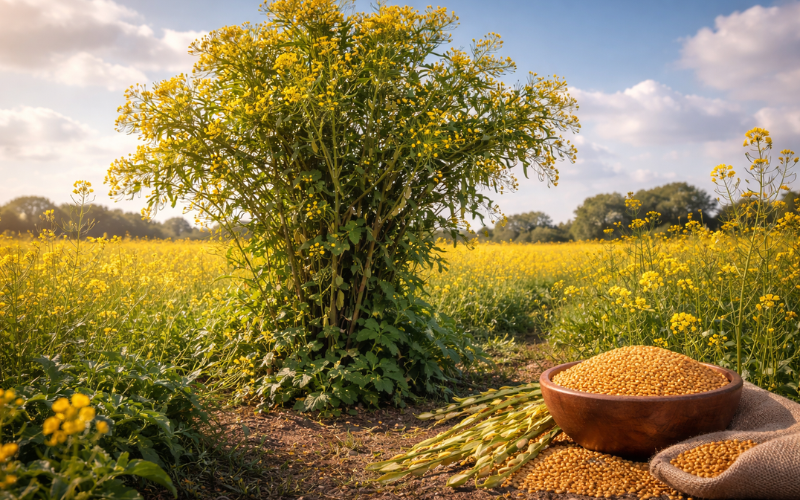
A mustard plant begins as a small seedling but can grow surprisingly tall in good conditions. Some varieties may reach two to three meters in height within a few months. They develop thin stems, clusters of bright yellow flowers, and slender pods that hold the seeds. Once the seeds mature, the plant’s life cycle ends.
Because of their rapid growth and upright structure, these plants can appear larger and more dramatic than many garden herbs. However, they never develop woody bark or permanent trunks, which is why they are not classified as trees.
Why Mustard Plants Can Appear Tree-Like in Some Conditions
Mustard plants are known for their speed. Under warm temperatures, full sunlight, and nutrient-rich soil, they can grow at an impressive rate. This fast development allows them to reach heights that surprise many gardeners.
In fertile farmland or wild fields, a dense group of mustard plants can create the impression of a small grove. Their stems may branch, and their seed pods can form thick clusters. From a distance, this growth pattern can look more like a shrub or small tree than a delicate herb.
Human perception also plays a role. When people compare mustard to tiny garden herbs like parsley or basil, a tall mustard plant feels tree-like by contrast. Over time, that visual impression influenced how people described the plant in everyday language and storytelling.
The Historical and Biblical Origin of the Mustard Tree Concept
The phrase mustard seed tree gained widespread recognition through religious and literary references. In some well-known teachings, a mustard seed is used as a symbol of growth, beginning very small but becoming large enough for birds to rest in its branches.
The point of these stories was not botanical accuracy but symbolic meaning. The mustard plant’s quick growth made it a powerful image of expansion and transformation. Translators and readers sometimes used the word “tree” to emphasize its size and impact, even though the plant was technically an herb.
Over centuries, these metaphors influenced how people thought about mustard. The term stuck in popular speech, and many readers assumed it referred to a literal tree rather than a poetic comparison.
Plants Sometimes Called the Mustard Tree Today
In some regions, the name mustard tree is applied to an entirely different plant known as Salvadora persica. This plant is a drought-tolerant shrub or small tree native to parts of Africa, the Middle East, and South Asia. Its leaves have a sharp, peppery taste that reminds some people of mustard.
Although it is sometimes called a mustard tree, it is not related to the mustard plants used for cooking. Instead, it is best known for its twigs, which are traditionally used as natural toothbrushes, often called miswak.
The shared nickname can easily mislead readers into thinking this tree produces mustard seeds. In reality, the similarity is based only on flavor and cultural naming, not botanical connection.
How to Grow Mustard for Seeds or Greens
Anyone interested in growing mustard does not need a tree at all. Mustard plants are easy to grow from seed and are often used in home gardens for both leafy greens and seed production.
They prefer cool weather and can be planted in early spring or autumn in many regions. The seeds germinate quickly, usually within a week, and the plants begin to mature within two to three months. If the goal is to harvest seeds, the pods should be allowed to dry on the plant before being collected.
Because mustard is an annual crop, it must be replanted each season. Gardeners should expect a short but productive growth cycle rather than a permanent tree that returns year after year.
Why the Term “Mustard Seed Tree” Still Confuses Gardeners and Readers
The continued confusion around the mustard seed tree comes from a mix of language, history, and modern search habits. Online searches often combine literal and figurative meanings, which can make it hard for readers to know which explanation applies.
Translation differences also contribute to the problem. Words used centuries ago to describe plants were often based on appearance or symbolism rather than scientific classification. As botanical knowledge improved, those older terms remained in common speech.
Today, horticulture clearly distinguishes between annual mustard plants and woody trees. Yet the phrase persists because it connects to familiar stories and cultural references. Understanding this blend of science and tradition helps explain why the term continues to appear in gardening guides, sermons, and internet searches.
Conclusion
The mustard seed tree is not a single botanical species but a phrase shaped by observation, metaphor, and naming traditions. The mustard seeds used in cooking come from fast-growing annual plants in the Brassica family, not from a tree. The idea of a mustard tree grew from the plant’s surprising height, its symbolic role in historical writings, and the existence of unrelated trees with mustard-like flavor.
For modern readers and gardeners, the key takeaway is simple. If you want mustard seeds or greens, you will be growing an herb that completes its life cycle in one season. The term “mustard seed tree” remains useful as a cultural reference, but scientifically it points to an idea rather than a specific tree.
FAQs
1. Is there really a mustard seed tree in nature?
No. Mustard seeds come from annual herb plants, not from a woody tree.
2. Why do some texts describe mustard as a tree?
The term is often used metaphorically to describe the plant’s rapid growth and symbolic meaning rather than its true structure.
3. Does any tree produce seeds used for mustard condiments?
No. Culinary mustard seeds come only from herbaceous plants in the Brassica family.
4. What is the tree sometimes called the mustard tree in South Asia?
That name is sometimes given to Salvadora persica, a shrub or small tree whose leaves taste sharp, but it is unrelated to culinary mustard.