

Introduction
If you’ve been comparing cars or SUVs lately, you’ve probably run into the same question most buyers ask 4WD vs AWD—what’s the difference, and which one do I actually need? On the surface, both systems can send power to all four wheels, which helps the vehicle grip better when the road is wet, slippery, or uneven. But the way they deliver that traction is not the same, and the best choice depends on where you drive and what you expect your vehicle to handle.
In everyday life, many people choose based on the badge alone. They assume “all four wheels” means “safe in any weather” or “ready for any trail.” The truth is more practical. AWD is commonly built for on-road control and confidence in changing weather, while 4WD is designed with tougher situations in mind—especially conditions where traction is limited and the vehicle needs extra pulling power at low speeds. This guide breaks down 4WD vs AWD in simple, real-world terms so you can decide with clarity, not guesswork.
AWD vs 4WD: The core difference in plain terms
The easiest way to understand 4WD vs AWD is to focus on how the system is used.
AWD (All-Wheel Drive) is usually automatic. In many vehicles, you don’t turn it on or off; the car manages it for you. AWD systems are designed to help you stay stable and keep moving when traction changes, like during rain, light snow, or when a road surface suddenly becomes slick. Some AWD setups run all the time, while others work mainly in two-wheel drive and send power to the other wheels only when needed.
4WD (Four-Wheel Drive) is often driver-selectable. In many trucks and off-road-focused SUVs, you choose when to engage it. Traditional 4WD systems are built to handle rougher conditions like deep mud, loose sand, rocky paths, and steep climbs. Many 4WD vehicles also offer a low-range setting, which is made for very slow, very difficult driving where extra torque is more important than speed.
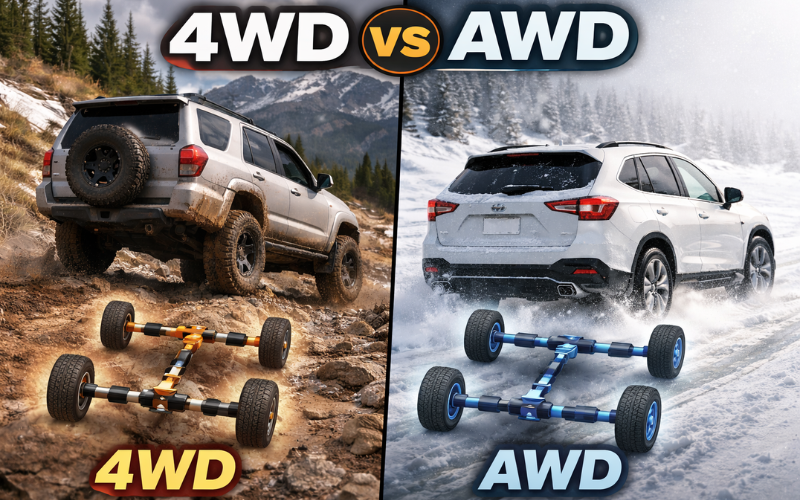
So while both systems can help traction, AWD is usually about everyday grip and stability, and 4WD is usually about maximum capability when conditions get serious.
How AWD systems work in real-world driving
AWD is popular because it fits the way many people actually drive. In normal conditions, the vehicle’s computer monitors traction and can shift power to the wheels that can use it best. You may not notice it happening, and that’s the point. AWD is meant to work quietly in the background so the car feels more controlled on slippery roads.
In real-world driving, AWD is most noticeable when a road is wet, when you’re pulling away from a stop on a slick surface, or when you’re going around a curve in the rain. It can reduce wheel spin and help the car stay composed. For many drivers, AWD feels like extra confidence. It does not turn a car into a snow tank, but it can make everyday winter driving less stressful.
Many modern AWD vehicles also work closely with traction control and stability control. If a wheel starts to slip, the car can reduce power and apply braking to that wheel so power can move to another wheel with better grip. This is why AWD can be so helpful in light snow or during heavy rain, especially on paved roads.
One important detail in the 4WD vs AWD discussion is that AWD is generally built with road comfort and efficiency in mind. It’s often found in crossovers and family SUVs because it supports daily driving rather than extreme terrain.
How 4WD systems work and what makes them tougher
4WD is built for situations where the road is barely a road—or isn’t a road at all. Many 4WD systems use a transfer case, which is a rugged component designed to split power between the front and rear wheels. In traditional setups, 4WD can lock power delivery in a way that helps the vehicle keep moving when one or more wheels are slipping a lot.
What makes many 4WD vehicles feel “tougher” is that they often include special modes for different conditions. A common setup includes 4-High, which can help on slippery roads at moderate speeds, and 4-Low, which is designed for slow, difficult driving like rock crawling, deep sand, or steep muddy climbs. 4-Low is not about going faster; it’s about giving the vehicle more pulling strength when it needs to move carefully and steadily.
Some 4WD vehicles also offer locking differentials or similar features that help both wheels on an axle turn together. This can be a big deal off-road because it improves the chance that at least one wheel on each axle can keep gripping. That said, not every 4WD vehicle has the same hardware, and not every “4×4” badge means the same capability. Still, as a category, 4WD is generally aimed at more demanding use than AWD.
A key warning in the 4WD vs AWD comparison is that many traditional 4WD systems are not meant to be used on dry pavement. When turning, your wheels need to rotate at slightly different speeds. If a system is locked in a way that prevents that, it can cause stress in the drivetrain. Some newer systems are more flexible, but it’s still smart to follow your vehicle’s manual.
Best situations for AWD (rain, light snow, everyday roads)
AWD is a strong fit if your driving is mostly on paved roads and you want extra stability when the weather changes. In the rain, AWD can help your tires maintain traction when accelerating, especially when roads are slick or painted lane lines and metal surfaces reduce grip. It can also help reduce the “one wheel spinning” problem when pulling away from a stop on wet pavement.
In light snow, AWD can make daily driving smoother. It helps you start moving more easily and can feel more stable as you travel through slushy streets or lightly snow-covered roads. For many people, AWD is a practical choice for winter commuting because it requires little thought. You don’t have to stop and switch modes; it simply helps when traction drops.
AWD also works well for mixed driving, like city traffic during the week and highways on the weekend. It’s common in crossovers because it supports the comfort and predictable handling most drivers want. In the 4WD vs AWD debate, AWD often wins for people who want year-round confidence without planning their driving around drivetrain settings.
It’s still worth saying clearly: AWD is not a substitute for good tires. In snow especially, winter tires can have as much impact as the drivetrain. AWD can help you go, but tires help you turn and stop.
Best situations for 4WD (mud, sand, rocks, steep trails)
4WD shines when traction is limited and the ground is loose, uneven, or steep. Mud is a classic example. When the surface is slippery and thick, a vehicle may need steady power to keep moving without losing momentum. 4WD can help keep power flowing in a way that supports forward motion when wheels are struggling for grip.
Sand is another situation where 4WD can be extremely helpful. Deep, soft sand can quickly stop a vehicle that doesn’t have enough traction and low-speed pulling ability. With the right settings and the right tires, 4WD can help you keep moving smoothly and reduce the risk of digging in.
Rocky trails and steep climbs are where 4WD, especially with low range, can feel like the right tool for the job. The vehicle can move slowly with more control, which is important when the ground is uneven and traction changes from one wheel to the next. If you regularly drive on rugged trails, live in a rural area with rough roads, or travel in places where the pavement ends often, 4WD may be the better match.
In the 4WD vs AWD comparison, 4WD is also worth considering if you frequently tow in low-traction conditions, such as pulling a trailer up a slippery incline. It’s not automatically “better for towing” in every case, but it can be helpful when traction is the limiting factor.
Fuel economy, maintenance, and long-term ownership costs
In general, AWD tends to be more fuel-efficient than traditional 4WD systems, mainly because many AWD vehicles are built for on-road use and are designed to balance traction and efficiency. Some AWD systems are on-demand, meaning they don’t constantly drive all four wheels under normal conditions, which can help fuel economy.
4WD vehicles, especially those built for heavy-duty use, often weigh more and include extra components that can add mechanical drag. This can reduce fuel economy compared to similar vehicles with AWD or two-wheel drive. That doesn’t mean 4WD is “bad,” but it is a trade-off for extra capability.
Maintenance depends on the vehicle and how it’s used. Both systems have additional parts compared with a simple two-wheel drive setup, which can mean more servicing over time. For AWD, repairs can sometimes be more expensive because the systems are often integrated with electronics and sensors. For 4WD, the hardware is usually built tough, but off-road use can add wear to components, and the transfer case and related parts may require regular fluid checks and service.
The most realistic way to think about cost is to match capability to need. Paying for 4WD you rarely use can feel wasteful, but choosing AWD when you truly need low-range off-road ability can be frustrating and costly in a different way.
How to choose between 4WD vs AWD for your driving needs
If your driving is mostly paved roads, commuting, school runs, errands, and highway trips, AWD is usually the smarter and simpler option. It gives you extra traction in rain and winter conditions without requiring you to change settings. It’s especially helpful if you live in a place where weather changes quickly and roads can be slick for part of the year.
If you regularly drive on unpaved terrain, face deep snow on unplowed roads, visit remote areas, or plan real off-road travel, 4WD is often the better tool. It’s designed for situations where you may need maximum traction and extra pulling strength at low speeds. The added control can be the difference between moving forward calmly and getting stuck.
It also helps to be honest about the kind of “off-road” you mean. Some people mean gravel roads and campsite paths. Others mean sand dunes, rocky trails, and steep climbs. AWD can handle many light-duty adventures, especially with good tires. But for more challenging terrain, 4WD is usually the safer bet.
Finally, remember the simplest truth in this whole conversation: neither AWD nor 4WD cancels out physics. They help you move, but they don’t automatically help you stop faster. Good tires, safe speed, and smart driving matter just as much as the drivetrain.
Conclusion
The 4WD vs AWD decision isn’t about which system sounds tougher—it’s about which one fits your real driving. AWD is designed to make everyday driving more stable and confident, especially in rain and light snow, with little effort from the driver. 4WD is built for tougher conditions, where traction is limited and extra low-speed strength and control can make a real difference.
If you want a stress-free system for daily roads and changing weather, AWD is often the best match. If your routes include rough terrain, deep mud or sand, steep trails, or unmaintained roads, 4WD is more likely to meet those demands. Choose the drivetrain that matches your environment, then support it with the right tires and good driving habits. That combination is what truly delivers safety and capability.
FAQs
1. Is AWD the same as 4WD?
No. AWD is usually automatic and designed mainly for on-road traction and stability. 4WD is often selectable and built for tougher conditions, including serious off-road use.
2. Which is better in snow: AWD or 4WD?
For everyday winter driving on plowed roads, AWD is often easier and more convenient. For deep snow, unplowed rural roads, or situations where you may need extra low-speed pulling power, 4WD can have an advantage.
3. Can you use 4WD on dry pavement?
Many traditional 4WD systems are not meant for dry pavement because they can put stress on the drivetrain during turns. Some modern systems are more flexible, but you should follow your vehicle’s manual.
4. Does AWD or 4WD help you stop faster on slippery roads?
No. AWD and 4WD help with traction while moving and accelerating, but stopping distance depends mostly on tires, road conditions, and braking. Tires and safe speed are still essential.