

Introduction
A cord of wood is a standard way to measure firewood. In plain English, it’s the amount of wood you get when it’s stacked into a specific-sized pile. The big reason people talk about cords is simple: firewood can be stacked loosely or tightly, cut short or long, and still look like “a lot.” A cord gives buyers and sellers a clear, shared measurement so no one has to guess.
This matters most when money is involved. If you’re paying for firewood, you want to know you’re getting what you paid for. If you’re selling it, you want a unit that’s easy to explain and defend. In the United States and Canada, the cord is widely treated as the official standard for firewood measurement, which helps protect consumers from vague terms like “a load” or “a pile.”
What a Cord of Wood Actually Measures
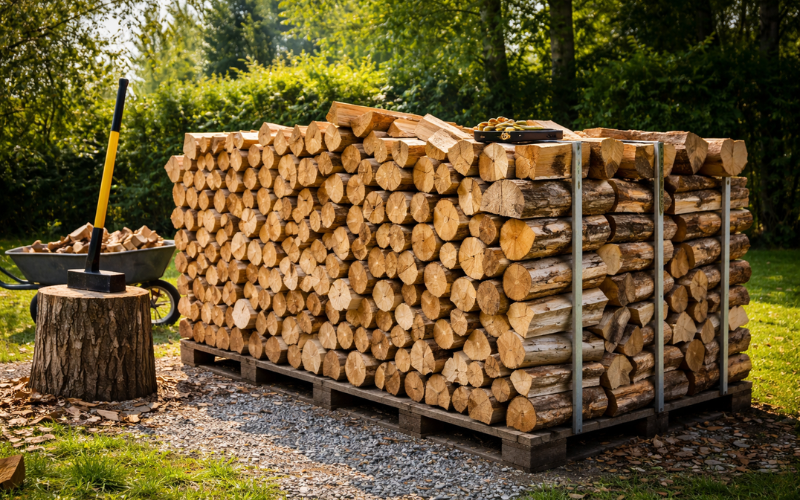
A full cord of wood is traditionally described as a neatly stacked pile that measures 8 feet long, 4 feet high, and 4 feet deep. When you multiply those dimensions, you get 128 cubic feet of stacked volume. That stacked volume is what defines a cord.
One detail people often miss is the difference between stacked volume and the actual solid wood. A stack of firewood always has air spaces between pieces. Because of those gaps, the true “solid wood” inside the stack is less than 128 cubic feet. The exact amount depends on how evenly the pieces are split, how curved the wood is, and how carefully it’s stacked.
That’s also why stacking method matters. If wood is tossed into a heap, it’s hard to compare one pile to another. But when wood is stacked with consistent rows and a flat top, it becomes measurable. If you want to know whether you received a real cord, measuring a clean stack is the most reliable approach.
Full Cord vs. Face Cord vs. Half Cord
A face cord (sometimes called a rick) can be confusing because it doesn’t have one universal depth. A face cord usually means a stack that is 8 feet long and 4 feet high, but the depth depends on the length of one piece of wood. Many firewood pieces are cut around 16 inches, so a 16-inch face cord is often about one-third of a full cord. But if the wood is cut to 18 inches or 24 inches, the face cord becomes larger. That’s why face cords can be useful locally but risky if the seller doesn’t clearly state the log length.
A half cord is exactly what it sounds like: half the volume of a full cord, or 64 cubic feet stacked. A quarter cord is 32 cubic feet stacked. These terms are more straightforward than “face cord” because they describe a fraction of the real cord.
You’ll also hear the word truckload. This is not a standard measurement because truck beds come in different sizes and wood can be stacked above the sides or thrown in loosely. Two “truckloads” can be completely different amounts of wood, which makes it a poor term for anyone who wants a fair, measurable deal.
How Much Firewood Is in a Cord
Many people ask how many pieces are in a cord of wood, but there isn’t a single number that’s always correct. The count depends on how long the logs are and how big the splits are. Smaller, thinner pieces increase the count. Larger, chunky pieces reduce it. That said, a full cord is commonly estimated to contain hundreds of pieces of split firewood.
Cut length also changes what you receive. If wood is cut to 16 inches, you can generally fit more rows into a standard stack depth compared with 18-inch wood, which changes how many pieces make up the same measured volume. The overall stacked volume stays the same for a cord, but the shape and number of pieces inside that volume can look very different.
How Much a Cord of Wood Weighs
The weight of a cord of wood can vary a lot. The biggest factor is moisture. Green wood (freshly cut) is much heavier because it holds more water. Seasoned wood (dried over time) weighs less and burns better. If you’ve ever tried lifting a fresh split log and compared it to a dry one, you’ve already felt the difference.
Wood species also matters. Hardwoods are usually denser than softwoods, so a cord of hardwood often weighs more than a cord of softwood at the same dryness level. Even within hardwoods, some types are heavier than others.
Moisture content affects weight so much that two cords of the “same” wood can feel totally different if one is properly seasoned and the other is still wet. This is also why transportation matters. A cord can be extremely heavy, especially if it’s green hardwood. If you’re hauling wood yourself, make sure your vehicle and trailer can handle the load safely. If it’s being delivered, the supplier’s truck is doing the heavy lifting—but you still want a safe unloading plan, especially if the driver is dumping rather than stacking.
How Long a Cord of Wood Lasts
How long a cord of wood lasts depends on how you use it. If you heat your home with wood as your main source, a cord can disappear faster than many people expect. In cold climates, a household may burn multiple cords in a season. In milder areas or in a well-insulated home, one cord can last much longer.
Stove efficiency also plays a big role. Modern, efficient wood stoves get more usable heat from the same amount of wood compared with older stoves or open fireplaces. The size of your home and how warm you keep it matter too.
If you use wood seasonally, like a few cozy fires each week, a cord may last a long time—sometimes even more than one season. If you rely on wood daily, the timeline shortens quickly. In practice, the best way to estimate is to look at your past usage. If you’ve burned through a certain stack size during a month of cold weather, you can scale that up to what a full cord represents.
Types of Wood Commonly Sold by the Cord
High-heat hardwoods are popular for home heating because they tend to burn longer and produce steady heat. They are often the go-to choice for wood stoves and long overnight burns. Softwoods usually ignite more easily and burn faster, which can be useful for kindling, quick fires, or shoulder-season burning when you don’t need hours of heat.
Choosing the right wood depends on your goal. If you want long-lasting heat, hardwood is usually the better match. If you want something that starts quickly and is easier to light, softwood can be convenient. Regional availability also matters. In some areas, certain species are common and affordable, while others cost more simply because they’re harder to source.
How to Measure and Verify a Cord of Wood
If you want to confirm you received a full cord of wood, the most reliable method is measuring a stacked pile. You’re aiming for the classic dimensions that add up to 128 cubic feet. The stack doesn’t have to be exactly 8 by 4 by 4, but the total volume should equal 128 cubic feet when stacked neatly.
Accuracy depends on how the wood is stacked. If the wood is piled loosely, it can look like a lot while actually being short. Under-stacking often shows up as a messy pile with uneven edges, large gaps, and no consistent rows. Another red flag is when a seller avoids stating the log length or uses vague terms like “truckload” without offering a measurement you can verify.
A smart approach as a buyer is to ask two simple things before purchase: the unit being sold (full cord, half cord, or face cord) and the log length. When the wood arrives, stacking it is not only good for storage—it also helps you confirm the amount.
Average Cost of a Cord of Wood in 2026
The cost of a cord of wood in 2026 can vary widely depending on where you live and what you’re buying. Some regions have abundant local firewood, keeping prices lower. Other places have higher delivery costs, fewer suppliers, or stricter supply, which pushes prices up.
Wood type also affects price. Hardwood commonly costs more than softwood because it’s often preferred for home heating. Seasoning matters too. Properly seasoned wood can cost more than green wood because it takes time, space, and work to dry it. Kiln-dried firewood is typically the most expensive because it goes through a controlled drying process and is often marketed as cleaner and ready to burn.
Delivery is another major factor. Some sellers price wood cheaply but charge a high delivery fee. Others bake delivery into the total price. Bulk buying can sometimes lower the per-cord cost, especially if you have the space to store it properly. If you burn wood regularly every year, buying earlier and buying more at once can be a practical way to save money.
Proper Storage to Protect Your Investment
The best stacking approach is simple and stable. Stack wood off the ground if possible to reduce moisture and rot. Leave space around the stack so breezes can pass through. This helps wood stay dry and continue seasoning if it isn’t fully dried yet.
Covering should protect the top from rain and snow, but you generally don’t want to wrap the entire stack tightly. Trapped moisture can slow drying and encourage mold. Many people cover only the top of the stack while leaving the sides open for airflow.
Pests are another reason to store wood wisely. Keep stacks away from your home’s siding when possible, and avoid bringing large amounts inside until you plan to burn it. Dry, well-stored wood is cleaner, easier to use, and less likely to cause problems.
Conclusion
A cord of wood is a practical, standard way to buy and sell firewood without guessing. It represents 128 cubic feet of stacked wood, and understanding that number helps you compare prices, verify deliveries, and plan your heating needs. Once you know the difference between a full cord, a face cord, and a half cord, you’re much less likely to be confused by vague terms or inconsistent stacks.
Whether you’re buying for a wood stove, a fireplace, or a full heating season, the best value usually comes from two things: getting the correct measured amount and making sure the wood is dry enough to burn well. With the right measurement and good storage, a cord of wood becomes one of the simplest and most reliable ways to stock up for the colder months.
FAQs
1. What is a cord of wood in simple terms?
A cord of wood is a standard amount of firewood measured by the space it takes up when stacked neatly. One full cord equals 128 cubic feet.
2. Is a cord of wood always 8 × 4 × 4 feet?
That’s the traditional way to describe it, but the key requirement is the total stacked volume. As long as the stacked pile equals 128 cubic feet, it counts as a full cord.
3. How many face cords are in a full cord?
It depends on the log length. With common 16-inch logs, a face cord is often about one-third of a cord, so it usually takes about three face cords to equal a full cord.
4. Why does a cord of wood have air gaps in it?
Because firewood pieces are not perfect cubes. When stacked, there will always be spaces between pieces, and that air space is part of the measured volume.