

Introduction
If you drive a Cadillac LYRIQ, you’ve probably noticed it offers different driving modes. These modes can make the car feel calmer, sportier, or more controlled on slippery roads. Naturally, a lot of owners ask the same question: do the driving modes in Cadillac LYRIQ offer different ranges or battery usages?
The short answer is driving modes can change how the car responds, and that can change how much energy you use. But most of the time, the mode itself is not “adding” or “removing” range like a magic switch. What really changes is how easy it is for you to use more or less power without noticing.
EV range and battery usage are usually measured in a few common ways. One is how many miles you can drive on a full charge (often shown as an estimated range on the screen). Another is how efficiently the car turns battery power into movement. That efficiency is often shown as miles per kWh (kilowatt-hour), which is simply “miles per unit of battery energy.” You don’t need to do the math every day, but the idea is simple: smoother driving usually uses less energy.
Understanding the Cadillac Lyriq Driving Modes
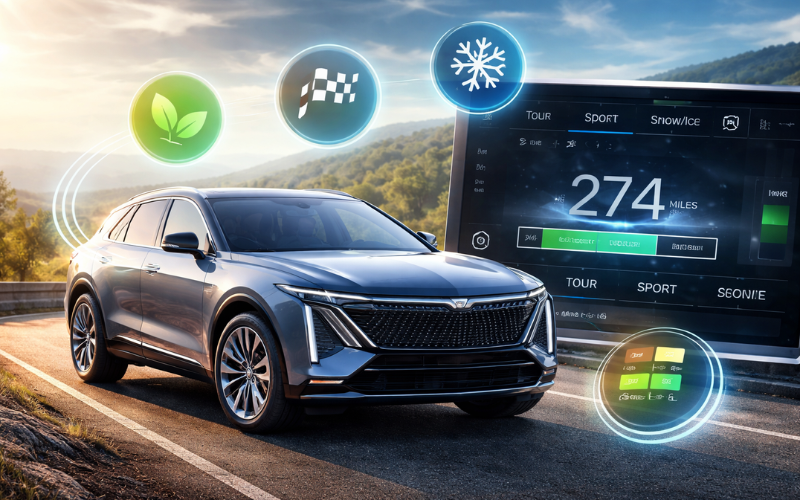
Cadillac’s own guide explains that Driver Mode Control lets you tailor the LYRIQ’s behavior based on road conditions and your preferences. The exact modes can depend on the model and equipment, but common options include Tour, Sport, and Snow/Ice, plus a custom mode (often called “My Mode”) on many trims.
Tour is basically the everyday setting. Cadillac describes it as normal acceleration with comfortable tuning for daily driving.
Sport is designed to feel more responsive, with sharper reactions when you press the pedal and a more “connected” feel.
Snow/Ice focuses on smoother, slower power delivery to help reduce wheel slip on slippery surfaces. Cadillac notes it adjusts the pedal map to slow acceleration and torque response.
These modes mainly adjust things like how quickly the car responds when you press the accelerator, how heavy the steering feels, and how traction systems behave. They can also influence how the car blends “coasting” and regenerative slowing, depending on settings and features you have enabled.
It’s also helpful to separate driving modes from battery modes. Some EVs have a clear “Eco” mode that limits power strongly to save energy. In the LYRIQ, the modes are more about driving feel and control than strict battery saving. That’s why the range difference often comes more from the driver’s behavior than from the mode itself.
How Driving Modes Influence Energy Consumption in an EV
When a mode makes the pedal more sensitive—like Sport—it can become easier to accelerate harder without meaning to. Hard acceleration uses more energy in that moment, and if you do it often, your overall efficiency goes down. On the other hand, a smoother pedal map—like in Tour or Snow/Ice—can make it easier to drive gently, which often helps range.
Regenerative braking is another key piece. EVs can slow down by turning the motor into a generator, sending some energy back into the battery. Cadillac’s LYRIQ supports One-Pedal Driving, and Cadillac explains you can turn it on or off and even customize how strong the braking feel is.
If you use stronger regen and you regularly slow down gradually (especially in city driving), you may recover more energy than if you coast and brake late. This doesn’t create free energy, but it can reduce waste during stop-and-go driving.
Climate control matters too. Heating and air conditioning can use a noticeable amount of power, and that impact can sometimes be larger than the difference between Tour and Sport on a calm commute. Driving modes usually don’t directly control your HVAC use, but some modes can encourage faster driving or quicker acceleration, which adds to total energy use on top of climate demands.
Do Cadillac Lyriq Driving Modes Technically Change the Estimated Range?
Your LYRIQ shows an estimated range on the dashboard. That number is a forecast, not a promise. It’s based on the battery level plus recent driving conditions and patterns. That’s why the number can rise or drop depending on how you’ve been driving lately.
So, do the driving modes in Cadillac LYRIQ offer different ranges or battery usages on the screen? Sometimes you’ll see the estimate shift after switching modes, but it’s usually because the car is reacting to what it thinks you’re about to do (or what you’ve been doing), not because the battery suddenly changed.
It also helps to understand the difference between EPA-estimated range and real-world range. Cadillac advertises up to 326 miles of EPA-estimated range for 2026 RWD models, with a 102 kWh rated battery pack.
EPA numbers are useful for comparison, but real driving range changes with speed, weather, terrain, and driving style.
A quick burst of fast acceleration can also cause a temporary spike in energy use, which might make the range estimate drop more quickly for a while. But that doesn’t always mean your long-term efficiency is ruined—it just means the car noticed you used a lot of power recently. If you return to smoother driving, the estimate often stabilizes.
Real-World Range Differences Between Tour, Sport, and Snow/Ice Modes
In normal conditions, Tour tends to be the easiest mode for steady, efficient driving. The pedal response feels natural and not overly sharp, which helps many people keep acceleration smooth. That usually leads to more consistent efficiency.
Sport can lead to higher energy use, but not because the LYRIQ is “wasting” battery by design. It’s because Sport typically makes it easier to use more power. The steering may feel firmer and the vehicle may feel more eager.
If you enjoy the quicker response and drive the same gentle way you always do, the difference may be small. But if Sport makes you accelerate harder or pass more aggressively, you’ll likely see range drop over time.
Snow/Ice is designed for control on slippery surfaces. Cadillac explains it slows acceleration and torque response to help prevent wheel slip.
On dry roads, this mode can feel less responsive. Efficiency can vary: smoother acceleration can reduce waste, but extra traction management (and winter conditions themselves) often reduce range. The bigger range hit in winter usually comes from cold temperatures and heating use—not the Snow/Ice mode alone.
The Role of Regenerative Braking in Battery Usage
Regenerative braking is one of the main reasons EVs can be efficient in city driving. In the LYRIQ, features like One-Pedal Driving allow you to slow down using the accelerator pedal, and Cadillac notes you can customize the braking strength through vehicle settings.
Does stronger regen meaningfully extend range? It can help, especially in stop-and-go traffic. If you’re driving in a city with frequent slowdowns, regen can recover some energy that would otherwise turn into heat in the brakes. However, the best strategy is still smooth driving: if you accelerate hard and then rely on regen to “get it back,” you still lose energy in the process. Regen is helpful, but it’s not perfect.
Regen tends to make the biggest difference in these situations:
- City driving with lots of red lights
- Rolling traffic where you frequently slow down and speed up
- Long downhill stretches where the car can recover energy while controlling speed
On steady highways, regen has less to do because you’re not slowing down much. That’s why highway speed often matters more than regen settings.
Custom Driving Settings and Their Impact on Efficiency
Many LYRIQ trims offer a customizable mode (often called My Mode) that lets you blend comfort and response. Cadillac notes that the available modes can depend on model and equipment, which is why some owners have more customization options than others.
Custom settings can influence efficiency mainly through pedal feel. If you build a custom setup that keeps acceleration response gentle (even if you like firmer steering), it can help you drive smoothly without feeling like the car is “too soft.”
A practical way to think about it is this: choose the settings that make it easy for you to drive calmly when you want efficiency, and save the sharper feel for times when you actually want it. The goal is not to “fight the car,” but to match the car’s response to your typical driving.
If you’re trying to optimize for longer trips, a calm pedal response plus consistent speed is usually more important than anything else the mode changes.
Factors That Affect Range More Than Driving Modes
Driving speed is a major one. Higher speeds on the highway demand more energy, and small increases can reduce range more than many drivers expect. Weather is another big factor. Cold temperatures can reduce battery performance and increase heating use. Hot weather can increase air conditioning use.
Terrain matters too. Climbing uses more energy; descending can recover some energy with regen, but not all of it. Tire pressure and vehicle load also play a role, because rolling resistance and weight affect how hard the motors have to work.
And finally, heating and air conditioning can noticeably change range. On days when you’re using strong heat or strong cooling, that extra power draw can be more significant than a simple mode change.
What Cadillac Lyriq Owners Should Expect in Daily Driving
For most owners, Tour will feel like the “set it and forget it” choice. It delivers a balanced feel and often supports steady efficiency without you thinking about it.
In urban driving, your range often depends more on how smoothly you accelerate and how you handle stops than on which mode you pick. In highway driving, steady speed and wind resistance often dominate energy use. That’s why some people see bigger range changes from speed choices than from switching between Tour and Sport.
Mode selection matters most when it changes your behavior. If Sport makes you enjoy quick bursts of acceleration more often, your battery usage will rise. If Snow/Ice helps you stay controlled and smooth in bad weather, it may reduce sudden wheel spin and wasted energy—though winter conditions can still reduce range overall.
A good balance is to use Tour for normal driving, switch to Sport when you truly want that sharper feel, and use Snow/Ice when roads are slippery and safety is the priority.
Conclusion
So, do the driving modes in Cadillac LYRIQ offer different ranges or battery usages? They can, but mostly in a practical, real-world way—not because the battery changes, but because the car’s response changes and that affects how you drive.
Tour generally supports smooth, steady driving, which often helps range. Sport can reduce range if it encourages stronger acceleration more often. Snow/Ice is about traction and control, and any range change you notice in winter is often caused more by cold weather and heating than by the mode itself. Regenerative braking settings, including One-Pedal Driving, can also influence efficiency—especially in city driving—by helping you recover some energy during slowdowns.