

Introduction
Understanding the HCN Lewis structure is an important step for students learning basic chemistry concepts. A Lewis structure is a simple diagram that shows how atoms are connected in a molecule and how electrons are arranged around them. In the case of hydrogen cyanide (HCN), the structure explains how hydrogen, carbon, and nitrogen share electrons to form stable chemical bonds.
Hydrogen cyanide has a simple formula, but its bonding pattern teaches several key ideas in chemistry, including valence electrons, multiple bonds, molecular geometry, and polarity. By studying the HCN Lewis structure, you can clearly see how atoms follow basic rules like the octet rule and how these rules influence the molecule’s shape and behavior.
Valence Electron Count in HCN
The first step in drawing the HCN Lewis structure is counting valence electrons. Valence electrons are the outermost electrons of an atom. These are the electrons that take part in chemical bonding.
Hydrogen has one valence electron because it is in Group 1 of the periodic table. Carbon has four valence electrons since it belongs to Group 14. Nitrogen has five valence electrons because it is in Group 15.
When we add them together, hydrogen contributes 1 electron, carbon contributes 4 electrons, and nitrogen contributes 5 electrons. This gives a total of 10 valence electrons for the HCN molecule.
This total is very important. The number of valence electrons tells us how many electrons we can use to form bonds and lone pairs in the Lewis structure. If we miscount at this stage, the entire structure will be incorrect. For HCN, working with 10 valence electrons ensures that we distribute them properly to satisfy the bonding rules.
Arranging Atoms and Forming Initial Bonds
Once we know the total number of valence electrons, the next step in building the HCN Lewis structure is arranging the atoms correctly.
Hydrogen is always placed on the outside of a structure because it can only form one bond. It cannot be the central atom. Between carbon and nitrogen, carbon is less electronegative, which means it is more likely to share electrons. Therefore, carbon is placed in the center.
The basic arrangement becomes hydrogen bonded to carbon, and carbon bonded to nitrogen. At this stage, we draw single bonds between hydrogen and carbon, and between carbon and nitrogen. Each single bond uses two electrons. Since we form two single bonds, we use four of the ten valence electrons.
After drawing these initial bonds, we have six electrons left to distribute. These remaining electrons will help complete the octet of the atoms.
Completing the Octet and Forming the Triple Bond
Hydrogen follows a special rule called the duet rule. It only needs two electrons to become stable, and it already has two from its single bond with carbon. That means hydrogen is complete.
Next, we look at nitrogen. To follow the octet rule, nitrogen needs eight electrons around it. We place the remaining six electrons around nitrogen as lone pairs. Now nitrogen has eight electrons, but carbon does not.
Carbon currently has only four electrons from the two single bonds. It needs eight electrons to satisfy the octet rule. To solve this, we convert two lone pairs from nitrogen into bonding pairs. This creates additional shared electron pairs between carbon and nitrogen.
As a result, the single bond between carbon and nitrogen becomes a triple bond. Now carbon has one single bond with hydrogen and a triple bond with nitrogen. Nitrogen has one lone pair left. At this point, all atoms satisfy their stability requirements.
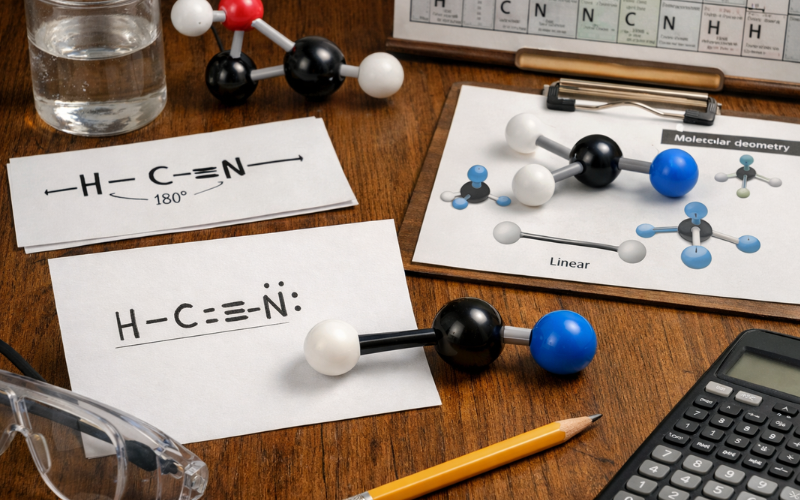
The final HCN Lewis structure shows hydrogen single-bonded to carbon and carbon triple-bonded to nitrogen, with one lone pair on nitrogen.
Formal Charge Verification
The formula for formal charge is the number of valence electrons minus the number of nonbonding electrons minus half the number of bonding electrons.
For hydrogen, it has one valence electron and shares two electrons in one bond. When we apply the formula, its formal charge is zero.
For carbon, it has four valence electrons and participates in four bonds. After calculation, its formal charge is also zero.
For nitrogen, it has five valence electrons, two nonbonding electrons in one lone pair, and shares six bonding electrons in the triple bond. When we apply the formula, its formal charge is zero as well.
Since all atoms in the HCN Lewis structure have a formal charge of zero, the structure is considered stable and correct. This confirms that the triple bond arrangement is the best representation of the molecule.
Molecular Geometry and Hybridization
Hydrogen cyanide has a linear molecular geometry. This means the atoms form a straight line. The bond angle between hydrogen, carbon, and nitrogen is 180 degrees. This happens because there are two regions of electron density around the central carbon atom: one bond with hydrogen and one triple bond with nitrogen.
According to basic bonding theory, two regions of electron density arrange themselves as far apart as possible. This results in a straight-line shape.
The central carbon atom in HCN is sp hybridized. In simple terms, this means that carbon mixes one s orbital and one p orbital to form two hybrid orbitals. These two orbitals form the two regions of electron density that create the linear shape.
Polarity of the HCN Molecule
Another important feature of the HCN Lewis structure is polarity. Polarity depends on differences in electronegativity, which is the ability of an atom to attract electrons.
Nitrogen is more electronegative than carbon, and carbon is more electronegative than hydrogen. Because of this difference, electrons in the triple bond are pulled closer to nitrogen. This creates a partial negative charge on nitrogen and a partial positive charge near hydrogen.
Even though the molecule is linear, the electronegativity difference creates a net dipole moment. This means one end of the molecule is slightly negative and the other end is slightly positive.
As a result, hydrogen cyanide is a polar molecule. This polarity affects how it interacts with other substances, especially in chemical reactions and solutions.
Conclusion
The HCN Lewis structure provides a clear example of how atoms share electrons to create stable molecules. By counting valence electrons, arranging atoms correctly, forming single and triple bonds, and verifying formal charges, we can accurately represent hydrogen cyanide.
The structure shows hydrogen single-bonded to carbon and carbon triple-bonded to nitrogen, with one lone pair on nitrogen. All atoms satisfy their stability rules, and the formal charges are zero. The molecule has a linear shape with a 180-degree bond angle, and the central carbon is sp hybridized. Because of electronegativity differences, HCN is also a polar molecule.
FAQs
1. What is the total number of valence electrons in HCN?
HCN has 10 valence electrons. Hydrogen contributes 1, carbon contributes 4, and nitrogen contributes 5.
2. Why does HCN have a triple bond?
Carbon needs eight electrons to satisfy the octet rule. Forming a triple bond with nitrogen allows carbon to reach stability.
3. Is the HCN Lewis structure linear?
Yes, hydrogen cyanide has a linear shape with a bond angle of 180 degrees due to two regions of electron density around carbon.
4. Is HCN a polar molecule?
Yes, HCN is polar because nitrogen attracts electrons more strongly than carbon and hydrogen, creating a dipole moment.