

Introduction
ICD 10 for hypokalemia is a medical coding term used to identify low potassium levels in patients. This code is widely searched by healthcare professionals, medical billers, and students because it plays a key role in diagnosis documentation, and clinical records. Understanding how this code works helps ensure accuracy in both patient care and medical billing.
What ICD 10 for Hypokalemia Represents in Clinical Practice
ICD-10 codes are part of a global system used to record diseases, symptoms, and health conditions in a standardized way. ICD 10 for hypokalemia specifically refers to a condition where the potassium level in the blood is lower than normal. Potassium is an essential mineral that supports nerve signals, muscle movement, and heart rhythm, so even mild imbalances can be clinically important.
In clinical practice, ICD 10 for hypokalemia allows doctors to clearly document the condition in patient records. This standardization ensures that healthcare providers across different facilities understand the diagnosis the same way. It also supports continuity of care, especially when patients move between hospitals, clinics, or specialists.
Hypokalemia itself is not a disease but a laboratory-confirmed electrolyte imbalance. The ICD-10 system classifies it under metabolic and electrolyte disorders, which helps place the condition in its proper medical context without requiring highly technical explanations.
The Primary ICD 10 Code Used for Hypokalemia
The primary ICD 10 code used for hypokalemia is E87.6. This is the standard code applied in adult and general medical cases where low potassium levels are present. When healthcare providers refer to ICD 10 for hypokalemia, they are most often referring to this code.
E87.6 is designed to cover most routine clinical situations where hypokalemia is diagnosed based on lab results and clinical assessment. It does not require the condition to be caused by a specific disease, medication, or genetic disorder. This makes it flexible and widely applicable in everyday medical settings.
Because E87.6 is clearly defined and universally recognized, it simplifies communication between clinicians, laboratories, and billing departments. It also ensures that hypokalemia is consistently tracked for clinical outcomes and population health data.
When More Specific ICD 10 Codes for Hypokalemia Are Required
While E87.6 is the standard ICD 10 for hypokalemia, there are situations where a more specific code is required. These cases usually involve patient age or an underlying condition that directly explains the potassium imbalance.
For newborns, hypokalemia is coded differently because electrolyte disturbances in the perinatal period are classified separately. In renal-related cases, hypokalemia may be linked to kidney tubular dysfunction, which requires a more precise diagnostic code. There are also rare inherited muscle disorders where low potassium causes periodic muscle weakness, and these conditions are not coded under E87.6.
Using the correct ICD 10 for hypokalemia in these situations is important because it reflects the true medical cause rather than just the lab finding. Accurate coding improves clinical clarity and prevents confusion during audits or reviews.
Clinical Criteria That Support Using ICD 10 for Hypokalemia
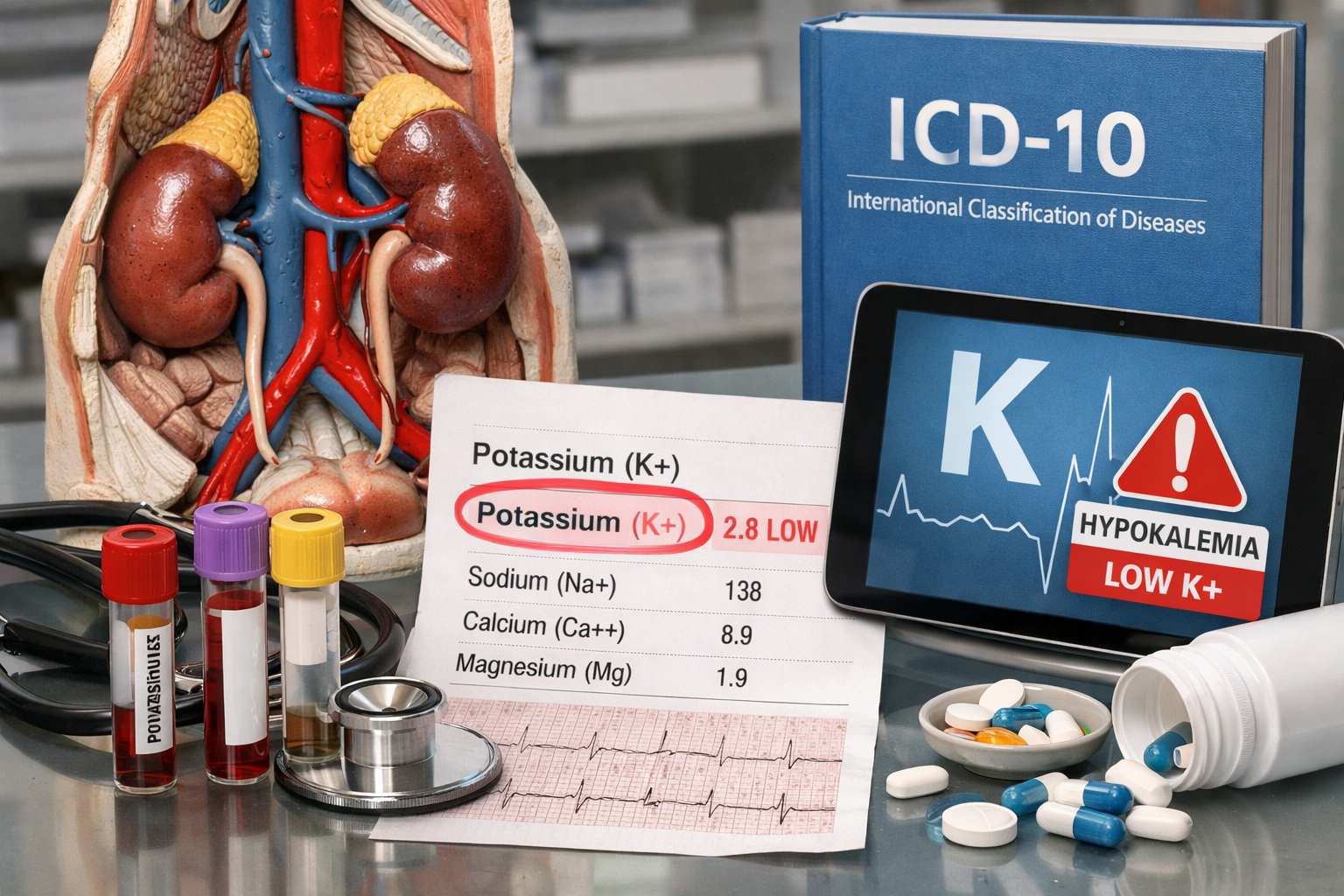
ICD 10 for hypokalemia is typically used when laboratory testing confirms that serum potassium levels are below the normal range. In most clinical guidelines, hypokalemia is defined as a potassium level lower than 3.5 mEq/L. This threshold helps providers decide when the diagnosis should be formally documented.
Clinical symptoms may or may not be present. Some patients have mild hypokalemia with no noticeable symptoms, while others experience fatigue, muscle cramps, irregular heartbeat, or weakness. Regardless of symptoms, the diagnosis is supported by lab evidence and clinical judgment.
Proper documentation is essential when assigning ICD 10 for hypokalemia. Medical records should clearly show lab results, provider assessment, and any treatment decisions. This ensures that the code accurately reflects the patient’s condition and supports medical necessity if the case is reviewed later.
ICD 10 for Hypokalemia in Medical Billing
In medical billing, ICD 10 for hypokalemia plays a direct role in reimbursement and claim approval. Diagnosis codes explain why tests, treatments, or hospital services were needed. When hypokalemia is documented correctly, it supports the services provided to correct the electrolyte imbalance.
Accurate coding helps reduce claim denials and delays. If the wrong ICD 10 for hypokalemia is used, insurers may question the diagnosis or request additional documentation. This can slow payment and increase administrative work for healthcare providers.
From a record-keeping perspective, correct coding also protects healthcare organizations during audits. Clear use of ICD 10 for hypokalemia shows that the diagnosis was medically justified and properly documented.
Common Coding Errors and Exclusions Related to Hypokalemia
One common mistake is using E87.6 when hypokalemia is clearly part of another condition that has its own specific code. Certain medical conditions, such as hormone disorders or pregnancy-related complications, require different ICD-10 codes even if low potassium is present.
Another error occurs when hypokalemia is coded without supporting lab evidence in the medical record. Coding should always match documented findings. Using ICD 10 for hypokalemia without proof of low potassium levels can raise red flags during billing reviews.
Understanding exclusions is just as important as knowing when to use the code. ICD-10 guidelines clearly state when E87.6 should not be used, helping coders avoid inaccurate reporting.
How ICD 10 for Hypokalemia Fits Into Current Coding Updates
ICD 10 for hypokalemia remains relevant and billable under current coding guidelines, including the most recent fiscal updates. The code E87.6 is recognized as a valid, billable diagnosis for recent and upcoming coding years, which confirms its continued importance in healthcare documentation.
While coding systems do evolve, hypokalemia remains a common clinical finding, and its classification has remained stable. This consistency helps healthcare professionals rely on the code without frequent changes or confusion.
Conclusion
ICD 10 for hypokalemia is an essential part of modern medical documentation, helping healthcare providers accurately record and communicate low potassium conditions. The standard code E87.6 covers most general cases, while more specific codes exist for newborns and condition-related hypokalemia. Understanding when and how to use ICD 10 for hypokalemia supports accurate diagnosis, proper billing, and reliable medical records. By applying the code correctly and staying aware of current guidelines, healthcare professionals can ensure clarity, compliance, and quality patient care.
FAQ
1. What is the correct ICD 10 code for hypokalemia?
The correct and most commonly used ICD 10 code for hypokalemia is E87.6, which applies to general and adult cases of low potassium.
2. Is ICD 10 code E87.6 billable in recent years?
Yes, E87.6 is a billable and valid diagnosis code under current ICD-10 guidelines, including recent fiscal years.
3. Can ICD 10 for hypokalemia be used for newborns?
No, newborn hypokalemia has a separate ICD-10 code specific to the perinatal period. E87.6 should not be used for newborn cases.
4. When should a different hypokalemia-related code be used instead of E87.6?
A different code should be used when hypokalemia is caused by a specific condition such as renal tubular disorders or inherited muscle diseases that have their own ICD-10 classifications.