

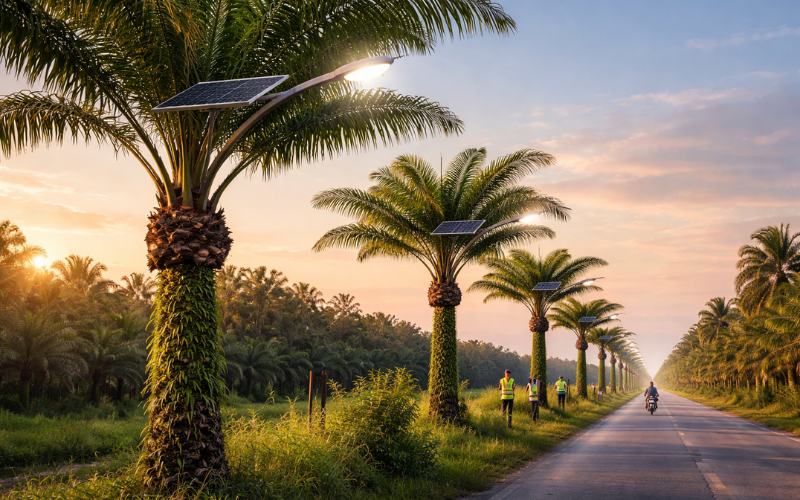
Introduction
Access to reliable and affordable lighting remains a challenge in many plantation zones and rural communities across palm-growing regions. In response, the oil palm lamp project street lamp oil palm model has emerged as a practical and innovative approach that combines local resources, simple technology, and sustainable thinking. These projects range from advanced street lamps designed for oil palm plantations to small community-led lamps powered by palm oil or its waste, offering new ways to improve safety, productivity, and quality of life.
Understanding the Oil Palm Lamp Project and Its Purpose
The oil palm lamp project street lamp oil palm concept refers to lighting solutions that are directly designed for areas where oil palm is grown or processed. It covers two closely connected ideas. The first involves street lamps built specifically for oil palm plantations, where standard lighting systems often fail due to harsh environmental conditions. The second focuses on community-level lamp projects that use palm oil or palm waste as a fuel source or construction material, especially in off-grid rural areas.
At the plantation level, the goal is to provide durable and energy-efficient street lighting that can withstand oil mist, dust, and high humidity. These lights are often solar-powered and require minimal maintenance. At the community level, the purpose is more basic but equally important: providing low-cost lighting using materials that are already available locally. Together, these approaches show how one agricultural crop can support both industrial infrastructure and everyday household needs.
Street Lamp Solutions Designed for Oil Palm Plantations
Oil palm plantations are not typical environments for outdoor lighting. Roads run through dense vegetation, harvesting often continues after sunset, and safety is a constant concern. Conventional street lamps, which work well in cities, often struggle in these settings. As a result, the oil palm lamp project street lamp oil palm model focuses on designing lighting systems that match the realities of plantation life rather than forcing standard solutions into unsuitable conditions.
Environmental Challenges Inside Oil Palm Plantations
One of the biggest challenges in oil palm plantations is airborne oil mist. During harvesting and processing, fine oil particles are released into the air and settle on nearby surfaces, including lamp covers and solar panels. Over time, this thin oil layer attracts dust and reduces light output and energy collection. High humidity and frequent rain add to the problem by accelerating corrosion, especially on metal parts.
Dust from unpaved plantation roads further blocks light lenses and solar panels, while insects are drawn to light sources at night, adding another layer of contamination. In many cases, these factors can reduce the efficiency of conventional street lights by a large margin within just a few months. This is why specialized designs are essential for oil palm plantation lighting.
Smart and Self-Cleaning Street Lamp Technologies
To address these challenges, modern oil palm street lamp projects use smart and self-cleaning technologies. Many systems rely on solar power, which removes the need for long cable networks in remote plantation areas. To keep solar panels working efficiently, some designs include self-cleaning features that remove oil film and dust automatically or through special surface treatments.
Oil-resistant coatings are applied to lamp covers and panels to prevent oil mist from sticking easily. These coatings allow rainwater to wash away dirt naturally, reducing the need for frequent manual cleaning. Poles and frames are often treated to resist corrosion caused by humidity and oil exposure. Together, these features make plantation street lamps more reliable, lower maintenance, and better suited to long-term use in oil palm regions.
Community-Based Oil Palm Lamp Projects for Rural Areas
Beyond plantation roads and industrial zones, the oil palm lamp project street lamp oil palm idea also plays an important role at the community level. In many rural areas near palm plantations, access to electricity is limited or unreliable. For these communities, palm oil and palm waste offer a familiar and accessible energy resource.
Community-based oil palm lamp projects focus on simple designs that can be built, repaired, and used locally. These lamps often provide basic lighting for homes, small shops, schools, or emergency situations. By using locally available materials, these projects reduce dependence on expensive fuels like kerosene and help communities make use of resources that might otherwise go to waste.
Using Palm Oil Waste and Byproducts in Lamp Design
A key strength of oil palm lamp projects is their ability to turn waste into something useful. Palm oil production generates large amounts of byproducts, many of which have limited economic value. Lamp projects offer a way to reuse these materials in a practical and visible way, supporting both sustainability and local creativity.
Palm Oil as a Direct Lamp Fuel
Palm oil itself can be used as a fuel for simple oil lamps. In some projects, used cooking oil, which is often palm oil-based, is collected and filtered before being reused for lighting. These lamps work in a similar way to traditional oil lamps but burn longer and cleaner than kerosene when properly designed.
For households without access to electricity, palm oil lamps provide a familiar and affordable source of light. They are especially useful during power outages, emergencies, or in areas where grid connections are not yet available. While these lamps are not meant to replace modern electric lighting, they offer a safer and more sustainable alternative to open fires or low-quality fuels.
Reusing Palm Waste for Lamp Structures
In addition to fuel, palm waste materials are often used to build lamp bodies and decorative parts. Empty fruit bunch fibers can be molded into lamp shades, while hard palm kernel shells are sometimes used as bases or structural elements. These designs not only reduce waste but also create products that reflect local culture and craftsmanship.
Using palm waste in lamp construction also lowers costs and encourages small-scale manufacturing. In some regions, these lamps are produced by local workshops or community groups, creating income opportunities and strengthening local skills.
Sustainability and Environmental Impact of Oil Palm Lighting Projects
A common question around the oil palm lamp project street lamp oil palm model is whether it is truly sustainable. The answer depends largely on how the palm oil is sourced and how the projects are managed. When palm oil and palm waste are used responsibly, lighting projects can reduce waste, lower emissions, and improve energy efficiency.
By reusing waste materials, these projects help reduce the environmental burden of palm oil production. Solar-powered street lamps further cut reliance on fossil fuels, while oil-based lamps reduce the need for kerosene in rural homes. However, sustainability also requires attention to sourcing. Palm oil used in lighting projects should come from producers that follow responsible land-use practices to avoid contributing to deforestation.
Economic and Social Benefits of Oil Palm Street Lamp Projects
The benefits of oil palm lighting projects go beyond energy access. In plantation areas, reliable street lighting improves worker safety, supports night-time operations, and reduces accidents along internal roads. This can lead to higher productivity and lower operational risks for plantation operators.
At the community level, affordable lighting extends productive hours for households and small businesses. Children can study after dark, shops can stay open longer, and public spaces become safer at night. By using local materials and labor, oil palm lamp projects also support local economies and create small but meaningful income opportunities.
Challenges and Limitations of Oil Palm Lamp and Street Light Systems
While the oil palm lamp project street lamp oil palm model offers many advantages, it also faces challenges. Maintenance remains an issue, especially for systems that rely on mechanical self-cleaning parts or specialized coatings. If spare parts or technical support are not available locally, even well-designed systems can fall into disrepair.
Scalability is another concern. Community lamp projects work well at a small scale but may struggle to meet the needs of larger populations. For street lighting, upfront costs can be higher than conventional systems, even if long-term savings are significant. Finally, sourcing sustainably produced palm oil is essential but not always easy, particularly in regions with weak certification systems.
Future Outlook for Oil Palm Lamp Project Street Lamp Oil Palm Solutions
Looking ahead, the future of oil palm lighting projects appears promising. Continued innovation in materials, coatings, and solar technology is likely to make plantation street lamps even more durable and affordable. At the same time, growing awareness of waste reduction and circular economy principles supports the expansion of community-based lamp projects.
Policy support and partnerships between governments, researchers, and local communities will play a key role in scaling these solutions responsibly. As energy access remains a global priority, the oil palm lamp project street lamp oil palm model offers a practical example of how local resources can be used to meet local needs.
Conclusion
The oil palm lamp project street lamp oil palm model shows how lighting solutions can be adapted to local environments and resources. By addressing the specific challenges of oil palm plantations and supporting community-level energy needs, these projects improve safety, reduce waste, and expand access to light. While challenges remain, thoughtful design, responsible sourcing, and continued innovation make oil palm-based lighting a meaningful part of the future energy landscape.
FAQs
1. What is an oil palm lamp project street lamp oil palm system?
It is a lighting solution designed specifically for oil palm regions, including street lamps for plantations and community lamps that use palm oil or palm waste as fuel or materials.
2. Are oil palm street lamps suitable for rural and off-grid areas?
Yes, many oil palm street lamps are solar-powered and designed for remote locations, making them suitable for rural and off-grid plantation areas.
3. How sustainable are lamps powered by palm oil or palm waste?
They can be sustainable when they use waste materials or responsibly sourced palm oil and are designed to reduce emissions and energy waste.
4. Can oil palm lamp projects replace conventional street lighting?
They may not fully replace conventional systems in cities, but they are highly effective in plantation environments and rural communities where standard lighting often fails.